
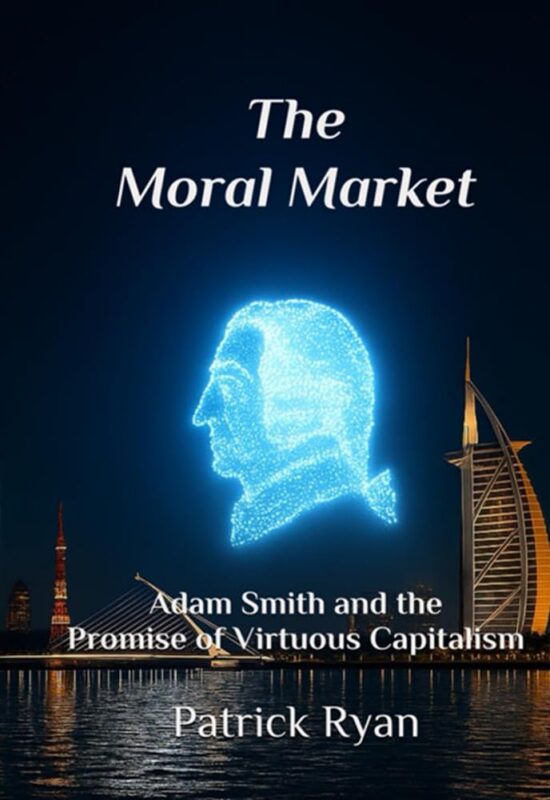
Patrick Ryan is the author of “The Moral Market: Adam Smith and the Promise of Virtuous Capitalism.”
Patrick argues that capitalism was never intended to be separated from morality. Modern business leaders often treat ethics as a compliance issue or a reputational concern. Adam Smith saw it differently. He believed markets only function when they are built on justice, reciprocity, and trust.
In this conversation, Patrick explains how shareholder primacy reshaped leadership thinking, why leaders should measure success beyond short-term financial performance, and how Smith’s concept of the impartial spectator can help leaders make better decisions when competing interests collide.
For leaders trying to balance performance, responsibility, and long-term value creation, this conversation offers a practical framework for making decisions that are both effective and principled.
Find episode 519 on The Leadership Podcast, on YouTube, channel @theleadershippodcast, or wherever you get your podcasts!
Watch this Episode on YouTube | Patrick Ryan on The Leadership Idea We Missed for 250 Years
Key Moments
[04:20] What have leaders fundamentally misunderstood about capitalism as a moral system?
[08:44] How does the duty of care in law connect to Smith’s impartial spectator concept?
[12:40] What practices should leaders adopt to institutionalize the impartial spectator?
[15:53] Performative leadership versus legitimate storytelling.
[21:14] Where does the rules and system play versus personal responsibility in leadership?
[25:25] Where have you personally struggled between what’s profitable and what’s just?
[28:53] For busy leaders without time to reflect—what’s your closing advice?

The Leadership Podcast is sponsored by W.S. Darley & Company.
Founded in 1908, Darley remains a family owned and operated business, providing the highest quality equipment solutions to our country’s warfighters and firefighters.
Learn more at darley.com and darleydefense.com
Memorable Quotes
"Morality is not a friction. It's actually the lubricant that makes markets work." Share on X "Prosperity without justice is mere plunder." Share on X "He believed that economic exchange was a way of creating trust, which is quite interesting really, using capital, an early form of capitalism, using competition, using economic exchange as a way of creating a commonality as opposed… Share on X "Morality and respect, and that level of reciprocity is the oil that generates everything. It's not extractive, it's value additive." Share on X "If a leader that performs integrity creates a culture that performs integrity, rather than a leader that is and has integrity. The tone from the top. It's vitally important." Share on X "Legitimate storytelling is the honest description of something that's actually happening. It's not a dishonest description of something you would like to happen." Share on X "The majority of us want to live a happy, healthy life where we have created value for our companies, we've created happiness in our families, we've done good works for our communities, and we're able to point to that and be proud… Share on X "You should neither be rewarded nor penalized for moral luck. You should be rewarded or penalized for the actions that you took yourself and the effect that you had in creating value." Share on XExplore the full archive at www.theleadershippodcast.com or wherever you get your podcasts!

This is the book mentioned in this series


Resources Mentioned
- The Leadership Podcast | theleadershippodcast.com
- Sponsored by | www.darley.com
- Rafti Advisors. LLC | www.raftiadvisors.com
- Self-Reliant Leadership. LLC | selfreliantleadership.com
- Patrick Ryan LinkedIn | www.linkedin.com/in/patrickryan
Still mulling over content from Jim Brown interview which was clear and simple. Difficult to put into practice 😄
Thank you for sharing such a great range of leadership perspectives.
James, the apostle said;
“Let every man be swift to hear, slow to speak, slow to wrath.”
2,000 years ago! 😉